
Introduction
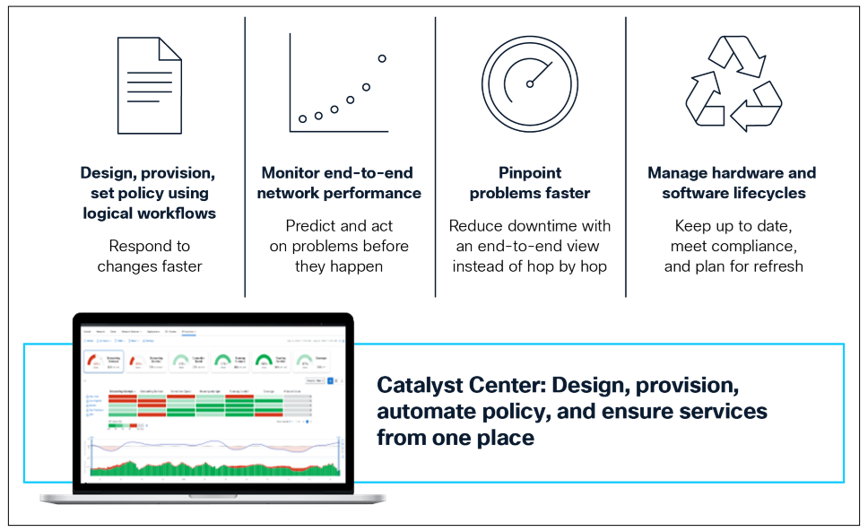
Cisco Catalyst™ Center, formerly Cisco DNA Center, is a powerful network controller and management dashboard that empowers you to take charge of your network, optimize your Cisco investment, and lower your IT spending. Catalyst Center provides a single dashboard for every fundamental management task to simplify running your network. With this platform, IT can respond to changes and challenges faster and more intelligently.
Design: Design your network using intuitive workflows, starting with locations where your network devices will be deployed. Users of Cisco Prime® Infrastructure and the Cisco® Application Policy Infrastructure Controller Enterprise Module (APIC-EM) can simply import existing network designs and device images into Catalyst Center.
● Policy: Define user and device profiles that facilitate highly secure access and network segmentation based on business needs. Application policies enable your business-critical applications to provide a consistent level of performance regardless of network congestion.
● Provision: Use policy-based automation to deliver services to the network based on business priority and to simplify device deployment. Zero-touch device provisioning and software image management features reduce device installation or upgrade time from hours to minutes and bring new remote offices online with plug-and-play ease from an off-the-shelf Cisco device. Additionally, the Cisco Secure Network Analytics (formerly Cisco Stealthwatch) service provisions network elements to send NetFlow and Encrypted Traffic Analytics (ETA) to the analytics service.
● Assurance: Enable every point on the network to become a sensor, sending continuous streaming telemetry on application performance and user connectivity in real time. This, coupled with automatic path-trace visibility and guided remediation, means network issues are resolved in minutes — before they become problems. Automated NetFlow switch configuration for Cisco Secure Network Analytics provides detection and mitigation of threats, even when they are hidden in encrypted traffic.
● Platform: An open and extensible platform allows third-party applications and processes to exchange data and intelligence with Catalyst Center. This improves IT operations by automating workflow processes based on network intelligence coming from Catalyst Center.
Catalyst Center
Catalyst Center is a centralized network management system to bring all this functionality into an integrated controller and present it through a single pane of glass. It can be deployed on a hardware appliance or as a virtual appliance.
How Catalyst Center works
Licensing
Catalyst Center is a software solution that offers flexible deployment options. It can be deployed either on the Catalyst Center hardware appliance or as a virtual appliance on AWS. The solution receives telemetry data from network devices including switches, routers, access points, and controllers. For a device to be authorized to send data to Catalyst Center, that device must be included in your organization’s Catalyst or Cisco DNA license subscription. Cisco encourages customers to purchase complete Catalyst Center functionality through a Catalyst or Cisco DNA Advantage license subscription. Limited Catalyst Center functionality is also available through a Cisco DNA Essentials license subscription. Wireless, switching, and SD-WAN and routing subscriptions are available for 3- and 5-year terms; wireless and switching are also available in a 7-year term. All Catalyst and Cisco DNA software license subscription options include embedded Cisco software support and downloads.
The links below open matrices detailing the main features included in each respective suite.
● Switching feature matrix
● Wireless feature matrix
● SD-WAN and routing matrix
In addition to the licenses, the Expansion Pack is a flexible way to purchase Cisco Identity Services Engine (ISE), Cisco Spaces, Cisco Secure Network Analytics (previously Stealthwatch), Cisco ThousandEyes®, and other licenses, appliances, and services in one convenient bundle. Enhance your Cisco networking solutions such as SD-Access, Cisco zero-trust solutions, Encrypted Traffic Analytics (ETA), location analytics, and assurance. You can add the pack to your Catalyst or Cisco DNA software licenses and choose the license count that fits your needs.
Introduction to Smart Licensing
Cisco Smart Licensing is a flexible licensing model that provides you with an easier, faster, and more consistent way to purchase and manage software across the Cisco portfolio and across your organization. And it’s secure – you control what users can access. With Smart Licensing you get:
● Easy activation: Smart Licensing establishes a pool of software licenses that can be used across the entire organization—no more Product Activation Keys (PAKs).
● Unified management: Cisco License Central (CLC) provides a complete view into all of your Cisco products and services in an easy-to-use portal, so you always know what you have and what you are using.
● License flexibility: Your software is not node-locked to your hardware, so you can easily use and transfer licenses as needed.
To use Smart Licensing, you must first set up a Smart Account on Cisco License Central.
For a more detailed overview on Cisco Licensing, visit the Licensing Hub.
Automation features
Table 1. Catalyst Center Automation features and benefits
Assurance features
Table 2. Catalyst Center Assurance features and benefits
SD-Access features
Table 3. SD-Access features and benefits
System and platform capabilities
Table 4. Catalyst Center system capabilities
Table 5. Catalyst Center platform capabilities
Table 6. Correlated insights
Latency requirements
Maximum latency supported, roundtrip time.
SD-Access platform scale
The following tables outline the Cisco SD-Access platform scale. The limits in this section are not necessarily dependent on Catalyst Center, but rather depend on the model of device and its capacity design.
Table 7. Cisco SD-Access control plane node scale
The control-plane scale does not depend on Ternary Content-Addressable Memory (TCAM); it only consumes memory.
Table 8. Cisco SD-Access border node scale
Fabric host entries include access points and classic and policy-extended nodes.
Additional border node scale considerations:
/32 (IPv4) or /128 (IPv6) entries are used when the border node forwards traffic from outside the fabric to a host in the fabric.
For all switches except Cisco Catalyst 9500 Series High Performance Switches and Cisco Catalyst 9600 Series Switches:
● IPv4 uses one TCAM entry (fabric host entries) for every IPv4 IP address.
● IPv6 uses two TCAM entry (fabric host entries) for every IPv6 IP address.
For the Cisco Catalyst 9500 Series High Performance Switches and Cisco Catalyst 9600 Series Switches:
● IPv4 uses one TCAM entry (fabric host entries) for every IPv4 IP address.
● IPv6 uses one TCAM entry (fabric host entries) for every IPv6 IP address.
Table 9. Cisco SD-Access Layer-2 handoff border node scale considerations
These numbers are the sum of the total numbers of endpoints both inside and outside the fabric site when the site has a border node with a Layer-2 handoff.
The border node with a Layer-2 handoff contains a combination of local and remote LISP entries.
Local entries = LISP database
Remote entries = LISP map-cache
Example:
The Cisco Catalyst 9300 Series Switches support 8000 total entries.
If the fabric site has 6000 endpoints (map-cache), then only 2000 endpoints (database) can be in the traditional network beyond the Layer-2 handoff.
Table 10. Cisco SD-Access edge node scale
Additional notes:
INFRA_VN is not a VRF definition. It is associated with the global routing table.
DEFAULT_VN is not user-defined; it is automatically created in Catalyst Center. It is present for historical (backward-compatibility) reasons; its use is neither necessary nor recommended.2
DEFAULT_VN, if used in host onboarding, is provisioned as a VRF definition and counts as a “user-defined VN.”
Table 11. Cisco SD-Access WLC scale
Table 12. Cisco SD-Access edge node scale for access points and wireless endpoints
The switches above have limits on access tunnels. An access tunnel is created between the fabric edge node and a fabric-mode AP that is either directly attached or attached through a directly-connect extended node.
Table 13. Cisco SD-Access embedded wireless controller scale
The embedded wireless scale is the same irrespective of the role of the device (edge, Fabric in a Box, border, or control plane).
Meraki integration
For existing Meraki branch customers who want to explore using Catalyst Center and Cisco Catalyst 9000 switches, or for customers with mixed environments, Catalyst Center now offers a single management pane of glass. This is an API-driven dashboard integration that supports all existing Meraki hardware and software at no additional license cost.
Meraki integration provides:
● Single dashboard inventory across all platforms (Meraki, Cisco Catalyst, Cisco Integrated Services Routers [ISRs], and Aironet)
● Up-or-down status of all devices in a single platform
● Use existing Meraki API keys; no additional license required
● Ability to assign SSIDs to Meraki access points from within Catalyst Center
Appliance scale
Catalyst Center offers flexible deployment options. It can be deployed on a hardware appliance or as a virtual appliance, on either VMware ESXi or AWS.
The third generation of the Catalyst Center appliance is available in three form factors and comes with the Catalyst Center image preloaded on it and ready for installation.
Tables 14 and 15 capture the scale information for Catalyst Center when deployed on physical appliances.
Table 14. Scale and hardware specifications
Note:
Table 15. Scale for 3-node DN3-HW-APL-XL cluster
Note:
Hardware appliance specifications
The Catalyst Center appliance is available in three form factors and comes with the Catalyst Center image preloaded on it and ready for installation. For more detailed information on these Cisco UCS appliances, click on the data sheet link beside each hardware series in Table 16.
Table 16. Physical specifications
Virtual appliance requirements
Catalyst Center can be deployed as a virtual appliance on AWS or VMware ESXi. For the system requirements, see Tables 17 and 18.
Table 17. Virtual appliance requirements for VMware ESXi
Table 18. Virtual appliance requirements for AWS
Fabric VN scale
Table 19 captures the fabric VN limits for devices in the fabric when deploying Catalyst Center Release 2.3.7.
Table 19. Fabric VN limits (The current maximum VRF validation is based on a lower limit of 1 and an upper limit of 128, even if the device can support more than 128).
Roles and privileges
Table 20. Role-based access control
Compatibility matrix
Catalyst Center provides coverage for Cisco enterprise switching, routing, and mobility products. For a complete list of Cisco products supported, please see our compatibility matrix, which is updated regularly.
Catalyst Center compatibility matrix: https://www.cisco.com/c/dam/en/us/td/docs/Website/enterprise/catalyst_center_compatibility_matrix/index.html.
Cisco SD-Access compatibility matrix: https://www.cisco.com/c/dam/en/us/td/docs/Website/enterprise/sda_compatibility_matrix/index.html.
Cisco environmental sustainability
Information about Cisco’s environmental sustainability policies and initiatives for our products, solutions, operations, and extended operations or supply chain is provided in the “Environment Sustainability” section of Cisco’s Corporate Social Responsibility (CSR) Report.
Reference links to information about key environmental sustainability topics (mentioned in the “Environment Sustainability” section of the CSR Report) are provided in the following table.
Table 21. Links to information about key environmental sustainability topics
Reference links to product-specific environmental sustainability information that is mentioned in relevant sections of this data sheet are provided in Table 22.
Table 22. Links to product-specific environmental sustainability information
Cisco makes the packaging data available for informational purposes only. It may not reflect the most current legal developments, and Cisco does not represent, warrant, or guarantee that it is complete, accurate, or up to date. This information is subject to change without notice.
Product usage telemetry
Product usage telemetry provides valuable information about the status and capabilities of the Catalyst Center appliance. Catalyst Center is configured to automatically connect and transmit product usage data to Cisco. Product usage telemetry is used by Cisco to improve appliance lifecycle management for IT teams who have deployed Catalyst Center. Collecting this data helps the product teams serve customers better. This data and related insights enable Cisco to proactively identify potential issues, improve services and support, facilitate discussions to gather additional value from new and existing features, and assist IT teams with inventory report of license entitlement and upcoming renewals.
All product usage telemetry data is transmitted to Cisco through an encrypted channel. The categories of data collected in the product usage telemetry are the Cisco.com ID, system telemetry, feature usage telemetry and network device (for example, switch or router) inventory, and license entitlement. The collection of product usage telemetry will be enabled by default and cannot be disabled from the product. Customers may contact the Cisco Technical Assistance Center (TAC) for changes in collection settings.
For detailed product usage telemetry information collected, please see Table 23.
Table 23. Catalyst Center product usage telemetry usage and benefits*
For information on Catalyst Center privacy, please refer to Cisco’s Personal Data Privacy.
Cisco Capital
Flexible payment solutions to help you achieve your objectives
Cisco Capital® makes it easier to get the right technology to achieve your objectives, enable business transformation, and help you stay competitive. We can help you reduce the total cost of ownership, conserve capital, and accelerate growth. In more than 100 countries, our flexible payment solutions can help you acquire hardware, software, services, and complementary third-party equipment in easy, predictable payments. Learn more.
For more information
See how Catalyst Center helps you move faster, lower costs, and reduce risk: https://cisco.com/go/catalystcenter.
Document history