
Photos by Andi Hedrick
This year we’ve decided to give the general public a taste of Porsche Panorama, PCA’s award-winning magazine, each month. We’ll be releasing Panorama articles once a week until we’re caught up, and then once per month from there. This is from the July 2023 issue.
Ask ten Porsche enthusiasts which new Porsche they want in their garages, and it’s likely at least five of them will say the 911 GT3. There was a time when such a simple answer would suffice because the GT3 traditionally came one way — big wing, manual transmission (and, for a time, only PDK) — but today buyers have options. Rear wing or no rear wing, manual or PDK, for example. In other words, you don’t have to fit Porsche’s ideal of a GT3 driver — you can spec one to your liking. Technical Director Manny Alban and Digital Media Coordinator Damon Lowney recently drove two GT3s to learn how the standard GT3 differs from a GT3 with the Touring package. Here’s what they found out, starting with Manny’s impressions.
For years I have argued that a GT3 meant performance. Period. Any discomfort was the price you pay to truly have a race car designed for the street. I mean, if you want comfort and power, get a Turbo, right? So, when we were invited to drive two GT3s — one with the Touring package and one without — I was curious to see how much had changed since the 991 and whether the Touring was really the “softer” of the two. I also was curious how someone 20 years younger than me would evaluate the same cars. In other words, what would the old guy (56, and perhaps closer to the average American GT3 buyer) pick, and what would the younger (35) choose as his favorite.
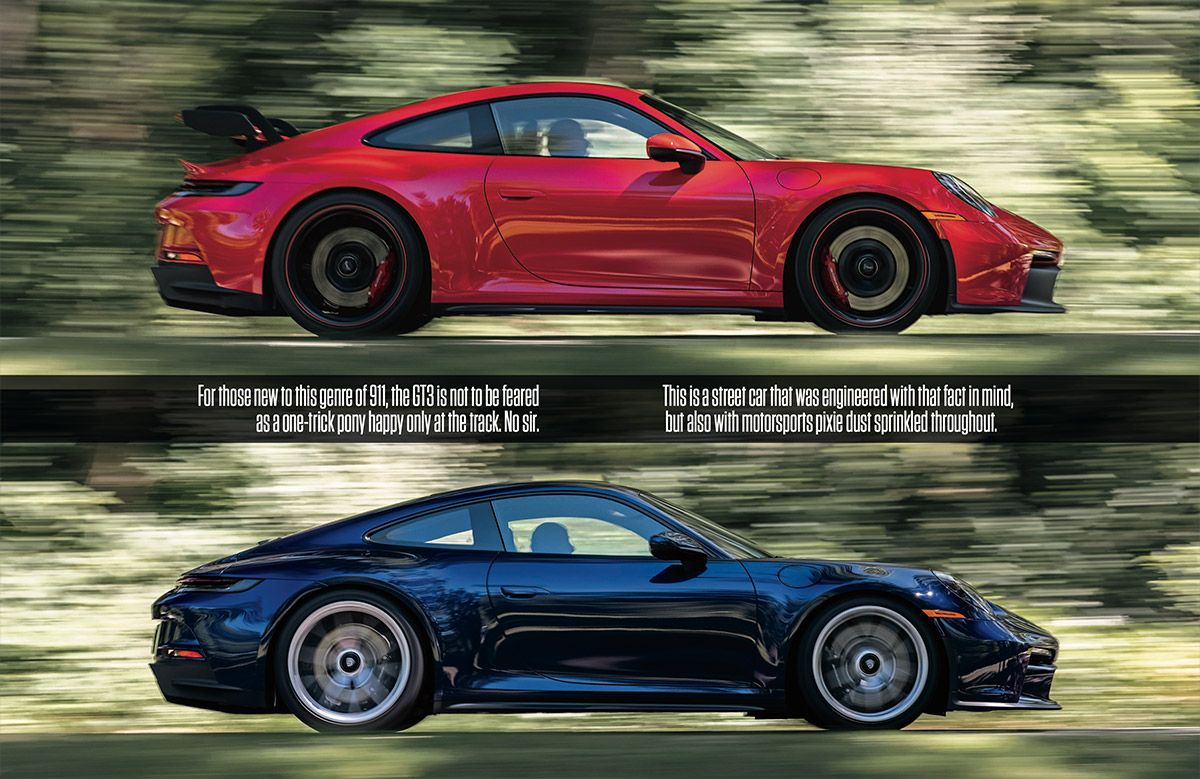
Much has been written since the debut of the 992 GT3, and almost all of it is very positive. Porsche doesn’t make slow cars. That’s a given. The other given is that the brand is all about evolution and not revolution. This means that 991 owners may not feel a night-and-day difference when getting into the latest GT3. For those new to this genre of 911, the GT3 is not to be feared as a one-trick pony happy only at the track. No sir. This is a street car that was engineered with that fact in mind, but also with motorsports pixie dust sprinkled throughout.
We had both cars for a full day and got to experience almost all types of roads and speeds — except a track. All told, it was about three hours in each car. It was plenty of time to become familiar with the ergonomics and ride quality, and to decide whether this is a car that we could live with and not just test drive.
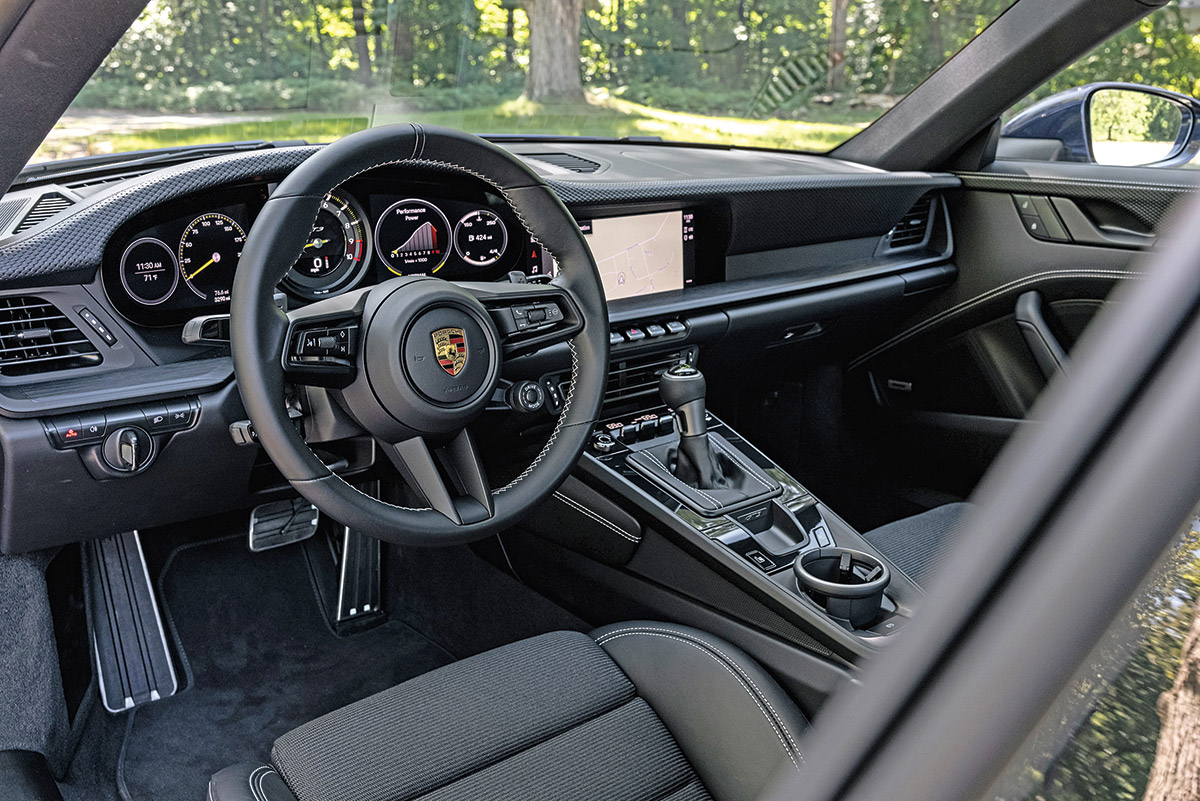 A leather-wrapped steering wheel replaces the standard Race-Tex on the GT3.
Where do they differ? If you are ordering the same options on both versions, then really the only difference, performance-wise, is the wing. Yes, the Touring has a slightly different front fascia treatment as well as some unique trim items. But all in all, these are the same cars. The question is, can you live with the wing or without?
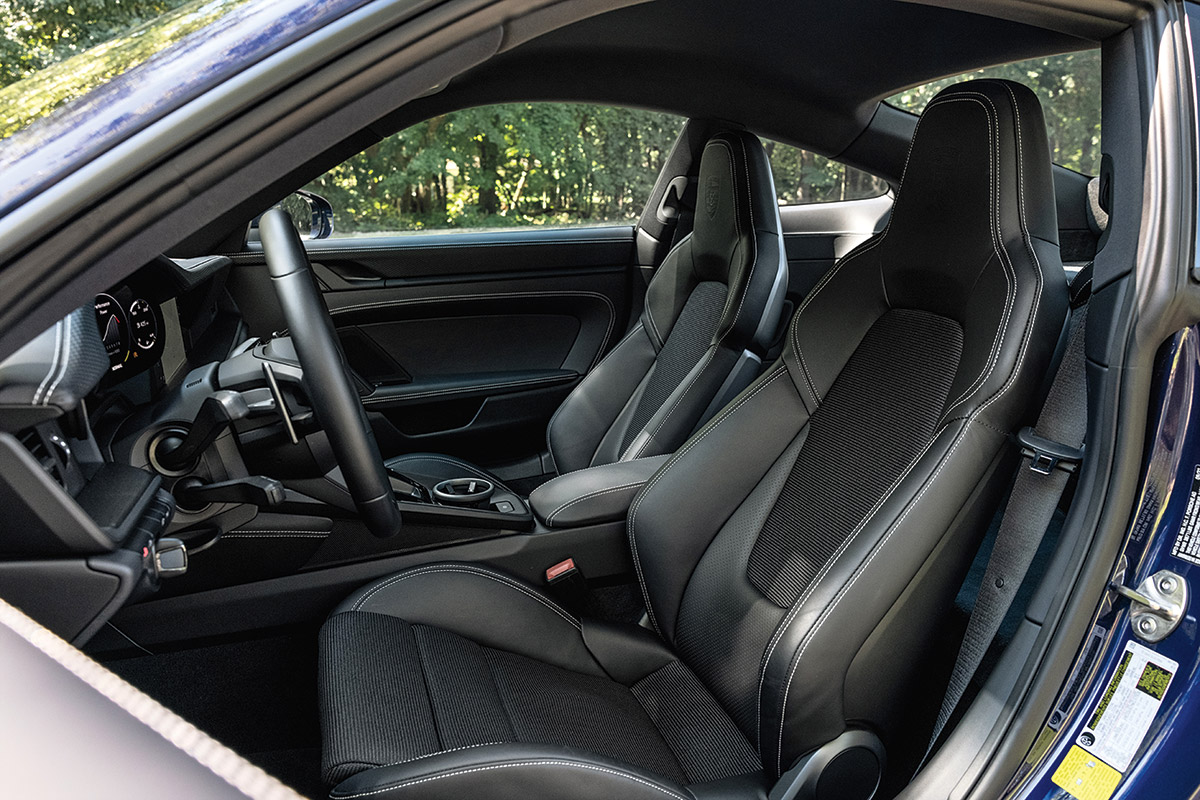 Get your GT3 Touring without the carbon-fiber buckets if you plan to drive it primarily on the road.
Remember, we didn’t take these on the track, so whether it was highway speeds or country road twisties, both cars felt the same. In fact, at one point when filming our video as we were test driving I forgot I was in the Touring and discovered that only when I glanced in the rearview mirror. Needless to say, we had to reshoot that clip, but it certainly reinforced my thoughts that the cars were truly identical.
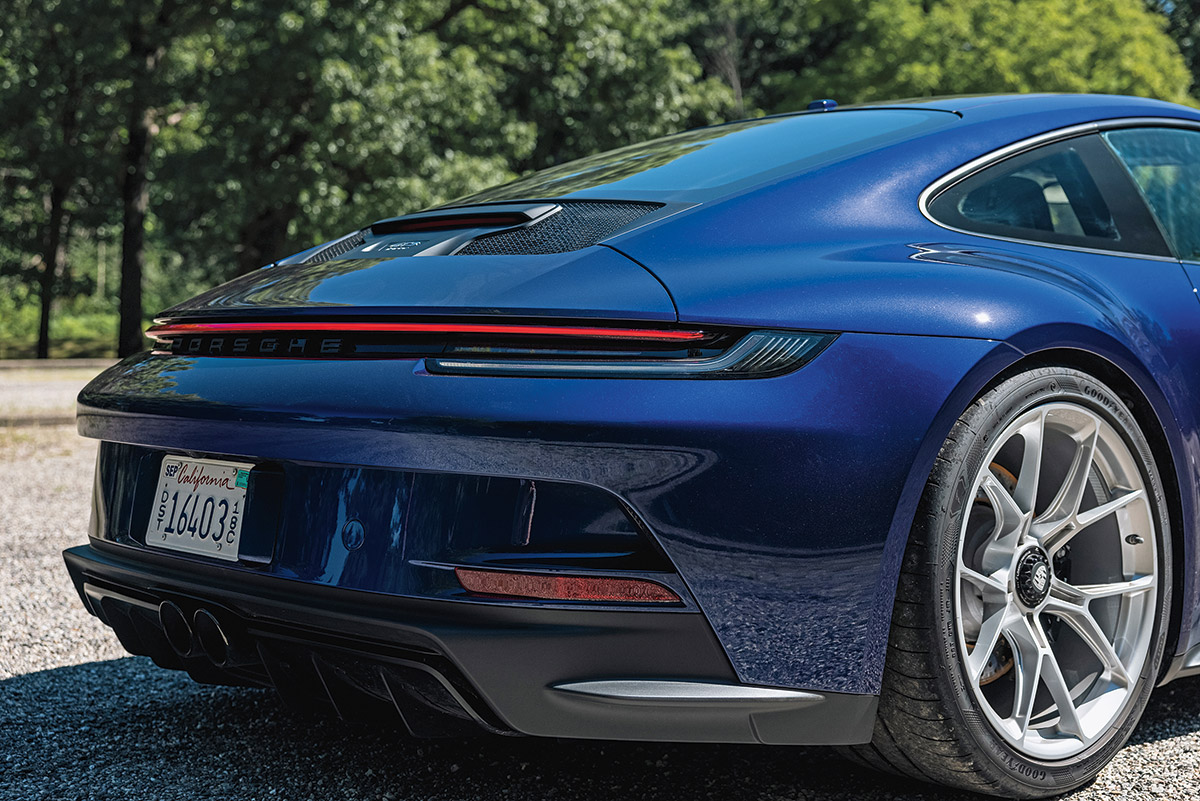 The main difference between a GT3 and a GT3 with the Touring package is the lack of a rear wing on the Touring.
Prior to driving the cars, I thought I would easily pick the GT3 as my choice if I had the means to purchase one. However, after spending time in each, I found that my taste may have matured as I’ve gotten older. I didn’t need that boy-racer Cup car look, but instead preferred the traditional lines of the 911. Had we driven it on the track and I knew that a big chunk of my time as an owner of this car would be on track, then the GT3 with the wing would probably have been the winner.
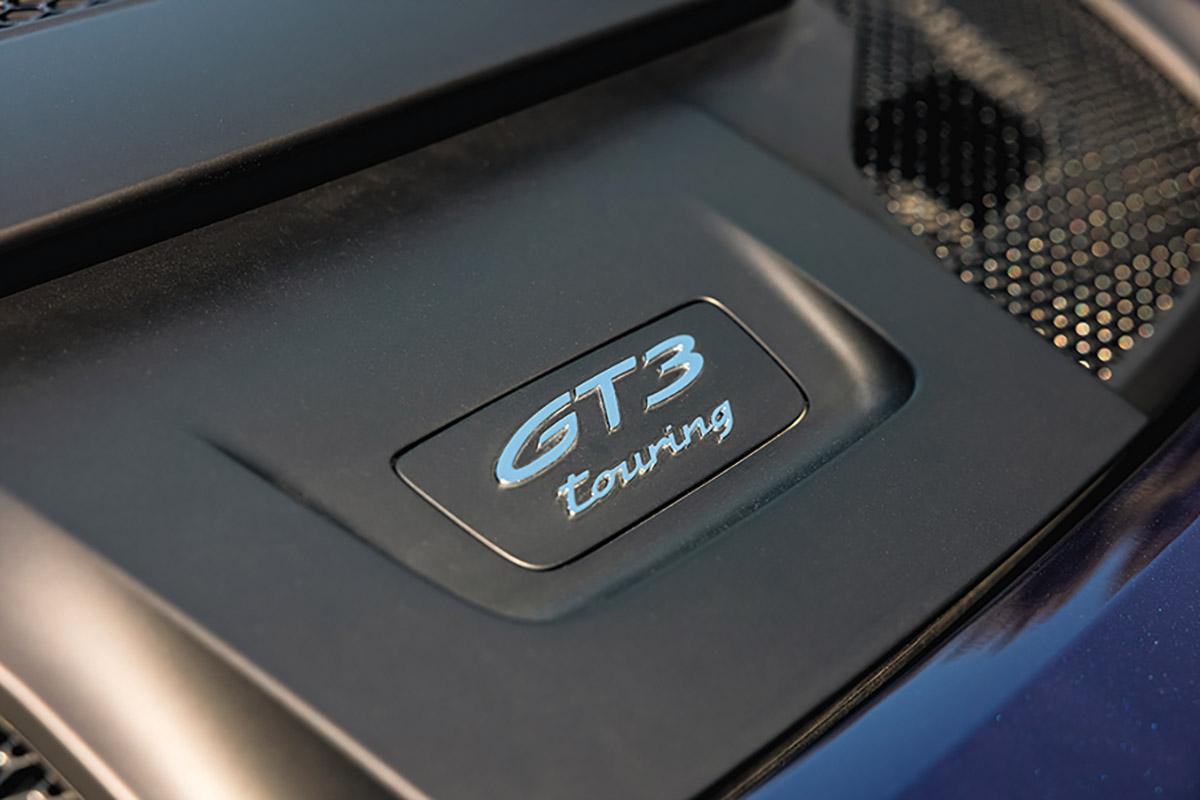
I have learned, though, to really love the Touring version of the GT3. Maybe it reminds me of a 911E of the 1972-’73 vintage: power when I need it, but still docile enough to take to dinner or even on a long road trip. While a 911 Carrera S or GTS has enough horsepower to satisfy almost everyone, the GT3 excels in the design of its chassis and how it communicates its every movement so accurately to the driver. And yes, I would order a manual transmission. The feel of the clutch and ease of shifting always left me feeling connected to the drivetrain. It reminded me of my 964 in that aspect.
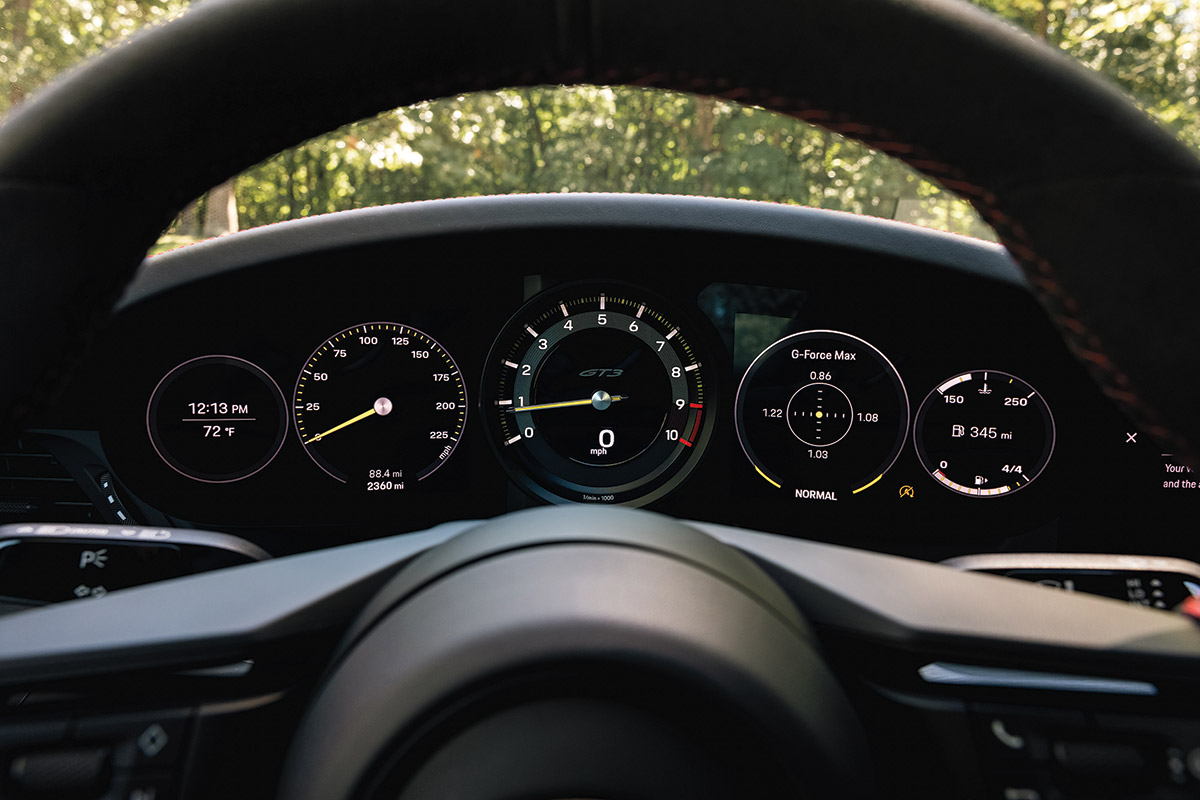
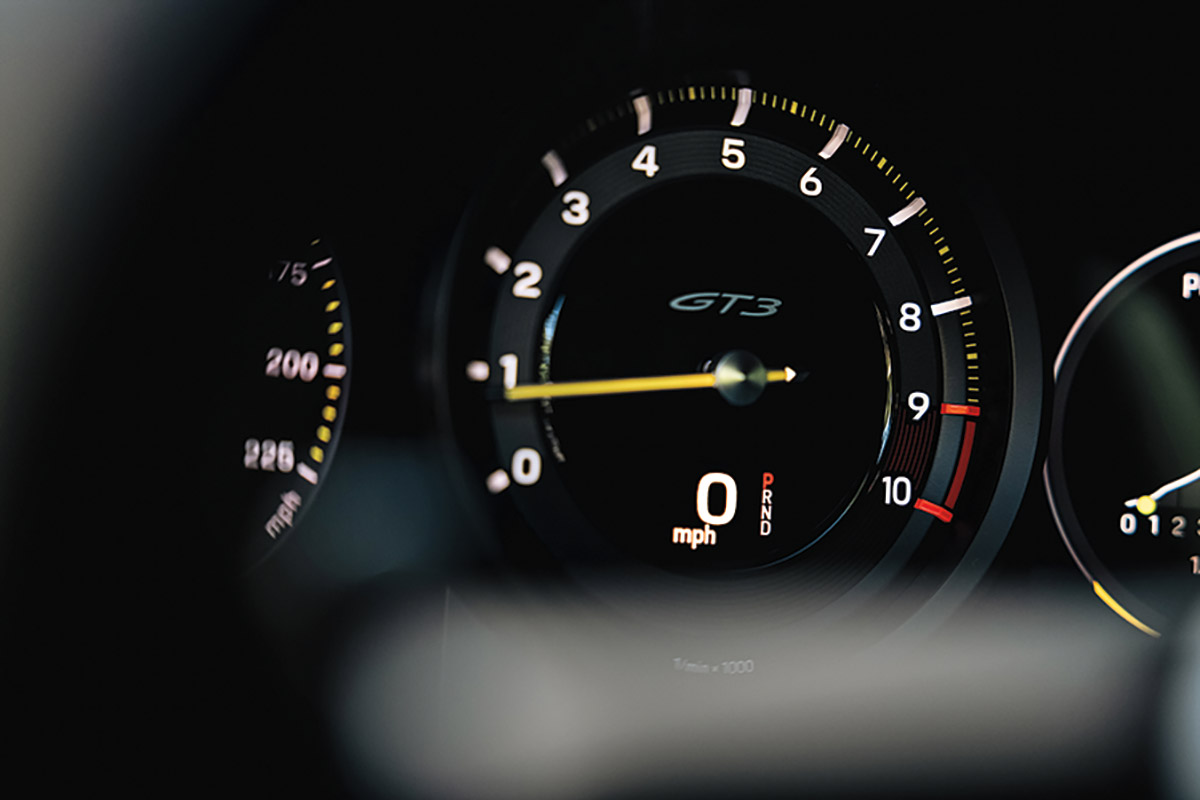 With 502 horsepower and a 9000 rpm redline, full throttle will raise the hairs on the back of your neck.
The genius of Porsche is how it has crafted a tool for whatever you’re looking to accomplish. And like many tools, it can excel in many different areas. This is the crux of a GT3: happy going on the town or at the track. — Manny Alban
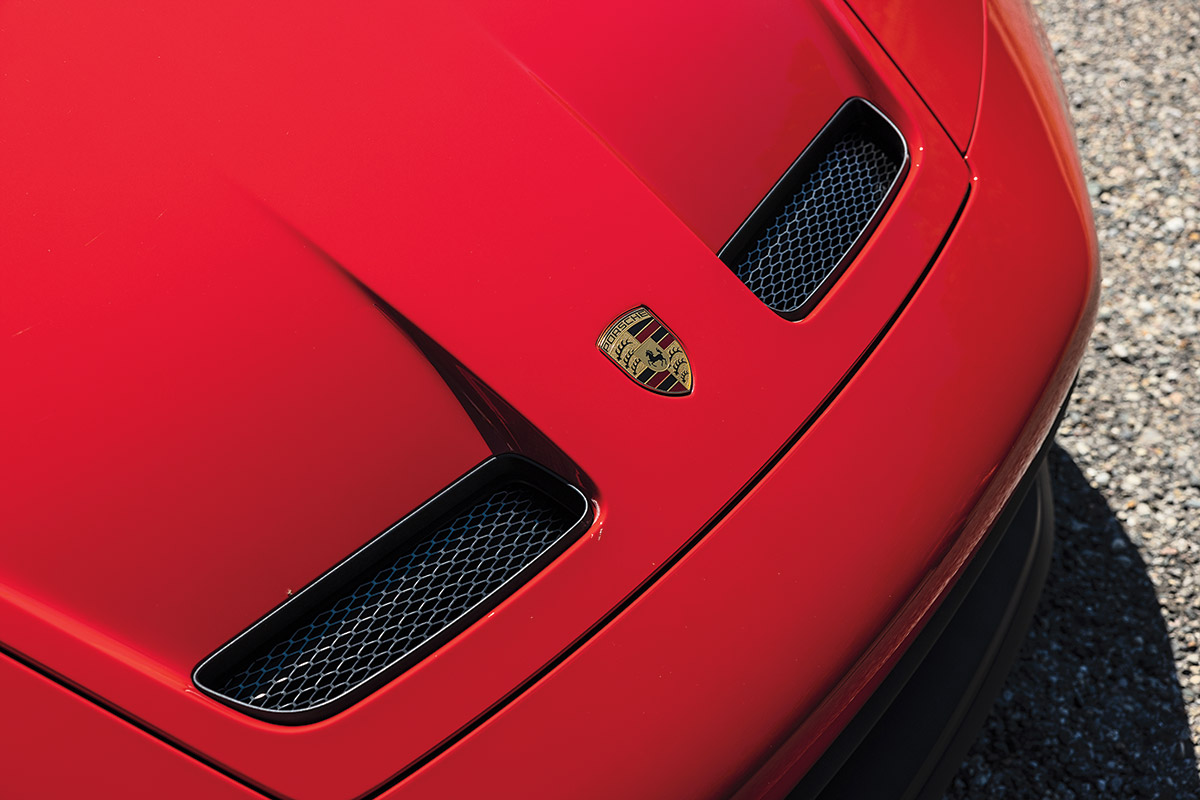
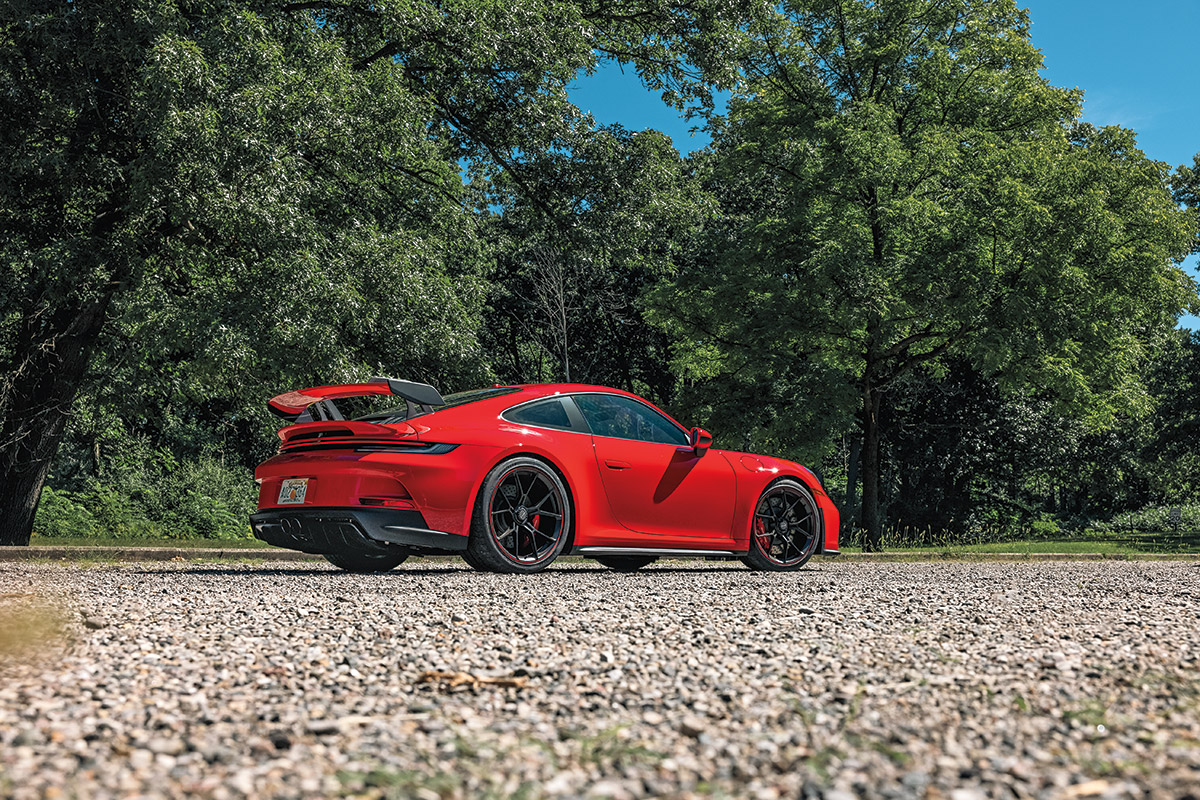
WHEN I THINK of a GT3, our Guards Red test car is what I picture. Bright color, big rear wing, and a manual transmission. A description like that sums up most GT3s since the very first one came to our shores in 2004, and it’s just how I like it. All new GT3s are equipped with a 502-hp naturally aspirated flat six that makes 346 lb-ft of torque, and it makes those numbers at stratospheric rpm compared with most other Porsches. Peak power is reached at 8400 rpm, while peak torque is at 6100 rpm, which is when I start to think about upshifting in my own 2007 Cayman. In a world where 7000 rpm is considered lofty, the GT3 dares you to kiss 9000 rpm before upshifting, over and over again. It’s a radical car that doesn’t do half-measures all that well, but it’s great at its core mission: putting a smile on your face at legal and beyond-legal speeds.
The 2022 GT3 Touring for this test is nearly a carbon copy of our standard GT3, though the few differences are obvious. There’s no fixed rear wing, it’s equipped with a seven-speed PDK double-clutch automatic transmission, and it’s Gentian Blue. The interior treatment is a bit different as well, with leather covering the steering wheel and gear knob, and a different upper dashboard material that evokes 911s of old. Likely because of the heavier PDK transmission, the Touring weighs in at 3,164 pounds, 38 pounds more than the standard car, a difference PDK more than makes up for with quicker shifts.
 The GT3 without the Touring package gets a sizable rear wing and matching front splitter to increase downforce.
When Manny and I arrived in Detroit to pick up the cars for the day, we found it somewhat ironic that the GT3 had the manual while the Touring had the automatic. Recall 2013, when Porsche announced the 991.1-generation GT3 would be PDK-only because it was faster on track. And then 2017, when the automaker announced the new 991.2 GT3: Customers could opt for a six-speed manual or seven-speed PDK for the first time, but the GT3 Touring would be available only in manual. Porsche’s reasoning was that those who opted for the Touring package wanted maximum engagement with the car, even at the expense of a few tenths of a second on track. It made sense at the time, but in retrospect, I don’t see the upside of not offering PDK.
 Centerlock wheels are standard on the GT3.
Porsche must have come to the same conclusion with the 992 GT3 Touring, so I could end my part of this comparison test and simply state, “Having a choice is the best choice,” and then hand the keyboard back to Manny. But instead, I’m going to make a couple of controversial statements about these two cars, and then bring in the GT3 RS to justify them. First, a standard GT3 is best served with the six-speed manual. Second, a GT3 Touring is better with PDK. And third, well, I’m not going to argue with Porsche’s decision to make the GT3 RS solely PDK. It’s the only one of these three cars whose sole purpose is to shave lap times. I wouldn’t want an RS with a manual.
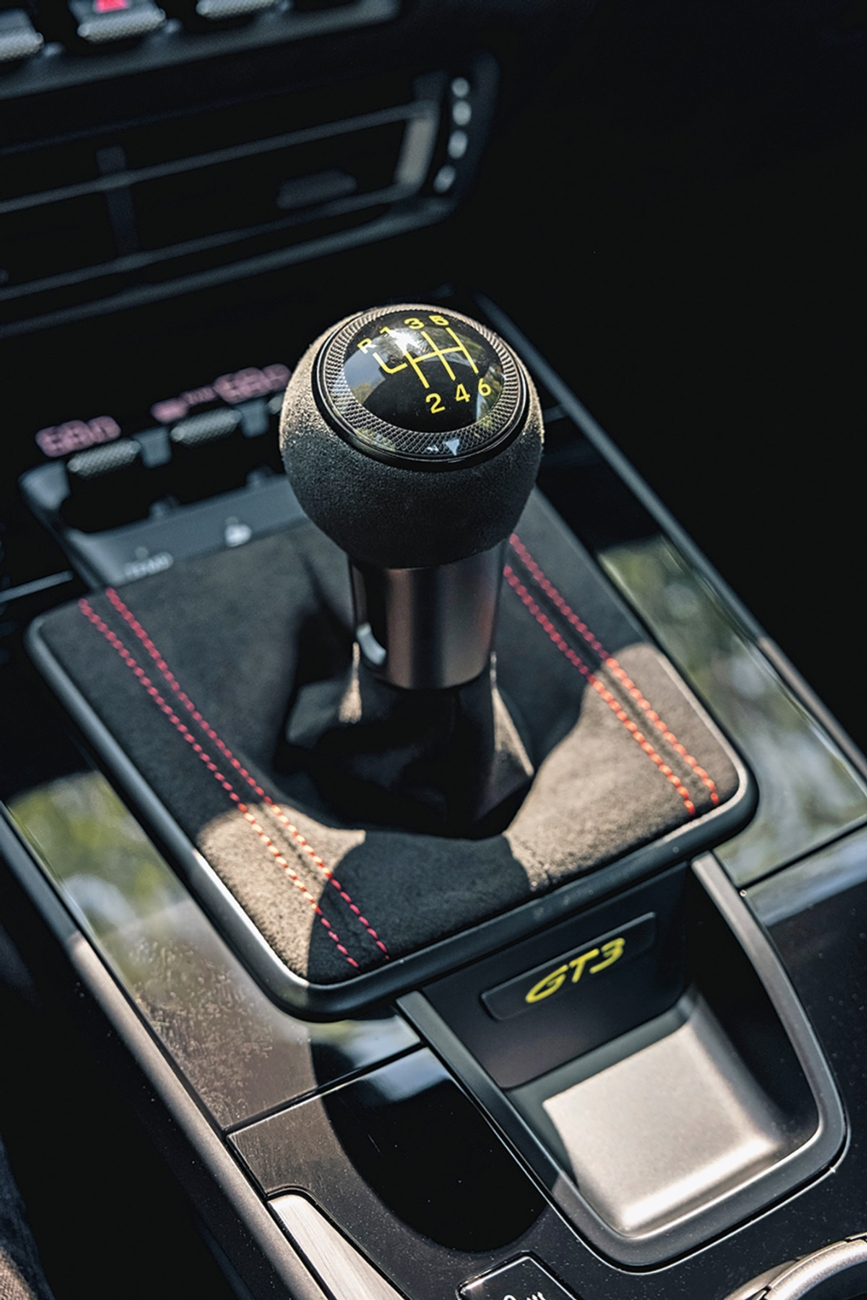 The six-speed manual transmission is derived from the 911R.
Some people (and Porsche circa 2015) might say I have my wires crossed. They’d tell me a GT3 is better with PDK because it’s more of a track car than the Touring, and therefore it should have the quicker-shifting transmission, right? Wrong. If I’m attending a track day to enjoy driving at and over the limit, that’s when I want maximum engagement. There’s no better time to practice the art of driving a sports car with a manual transmission than at the track. Also, would you rather take Turn 1 at Laguna Seca with or without a rear wing? Given the option, I’ll pick the GT3 every time.
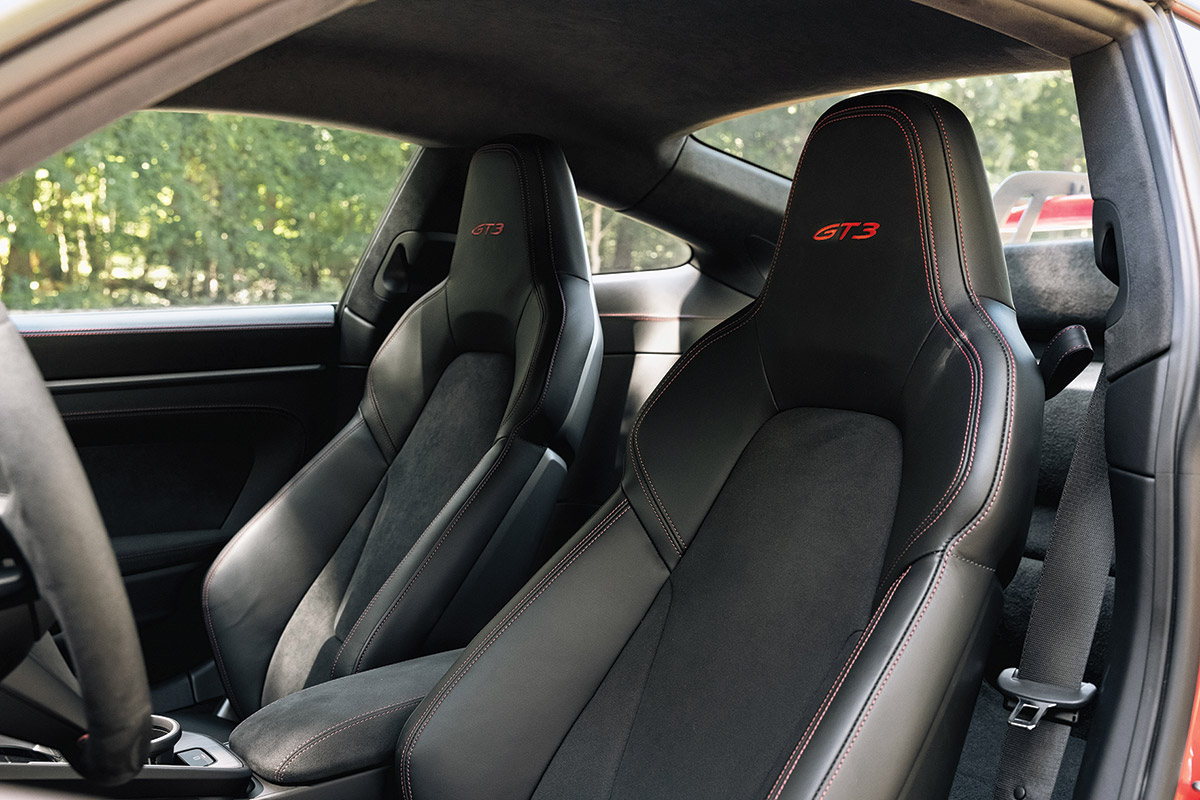 Both our GT3 and GT3 Touring had Sport seats.
Now here’s why the GT3 Touring is better with PDK. On back roads outside of Detroit, we learned that the suspension, which is and feels identical between the two cars, is compliant enough to be tolerable on public roads — the smoother the better. We also learned 992 GT3s love to tramline, thanks to the wide front tires and aggressive suspension. A relaxed commute a GT3 does not make, whether equipped with the Touring package or not. However, if I were to purchase a GT3 in which to commute, I would go for the Touring and opt for PDK. The lack of a rear wing instantly lowers the profile of the GT3 and might allow it to slide under the radar in certain situations. There’s also no wing to obstruct the rearview mirror. Furthermore, I’d much rather have the transmission shift gears for me on the 48-mile roundtrip slog from my home to the office. PDK is excellent at mimicking the low-speed behavior of a torque-converter automatic, yet is even better at banging off shifts at full boil. In short, if I were driving a GT3 daily, I’d want to make it as easy as possible. But even with PDK and no wing, a GT3 Touring is hardcore, and that’s why it’s my second choice: I wouldn’t buy a GT3 and drive it every day, and therefore I would not go for the Touring package or PDK. Avoiding potholes, watching out for distracted drivers, parking at the lonely end of the lot — it would get old fast.
Since we drove these two GT3s, Porsche launched the new GT3 RS, and this aero-heavy car drives my point home about choosing a standard GT3 with a manual instead of PDK: If you really want to be the fastest person on track, there are far better tools to accomplish this, and the GT3 RS is just one of them. For the average driver like myself, who might chase but rarely (if ever) achieve the fastest lap times, the standard GT3 with a manual transmission is just right. — Damon Lowney
Want to receive more great Porsche content?
Subscribe to e-Brake News
Related Stories:
» COVERED 01 | Book Review» The Future of Performance: A Deep Dive into Porsche’s T-Hybrid Tech | Tech Tactics» Porsche GT boss Andreas Preuninger reveals the secret sauce behind the GT3 S/C» PCA Juniors Review: Porsche 911 GT3 RS LEGO Speed Champions» Out with the old, in with the new | 2013 Carrera S vs. 2024 Carrera T