
If you found this page you more than likely are having issues with “hesitation and bogging” during throttle application in a Miata. This is somewhat of a common problem for this generation of Miata. My issues were primarily below 4000 rpm, and after the engine had warmed up. Throttle response was seemingly normal across all rpm ranges with a cold engine. With a warm engine and above 4000 rpm the acceleration seemed normal. A warm engine is indicated by the O2 sensor sensing a warm exhaust manifold. The troubleshooting I’ve done here is specific to a 1.8L 1995 Miata, you may apply what I’ve done here for your application.
This may have been a problem that has been stewing for awhile but became such an issue at Hallett this past summer that I had to solve it.
Video of the issue with a warm engine [Note the misfires, VERY bad news, indicates a VERY lean condition and can damage the engine]:
The simple “golden rule” with any debugging is start with what is most simple and least expensive and work your way up. Remember, the internal combustion engine is simply an air pump and needs i). air, ii). fuel and iii). spark, or ignition, to function. Keep that in mind during any troubleshooting of engine issues.
The Haynes manual describes these steps, in order, to tackle “Hesitation and stumble during acceleration”:
- Ignition timing
- Ignition system not operating properly
- Dirty or clogged fuel injectors
- Low fuel pressure
Below is the order of troubleshooting that I went through to solve my issue and may help you solve yours:
MAF (Mass Air Flow) Sensor
From prior experience I know issues with the MAF (Mass Air Flow) can cause SERIOUS issues with acceleration. [Note: I was at Autobahn Country Club near Joliet, IL a few years ago and ran across the FIA rumble strips pretty aggressively on corner exit and jarred the piping connecting the air inlet to the throttle body loose. I immediately went offline, struggled back to the paddock and discovered the issue when I opened the hood]. So check all of your connections and vacuum hoses and make sure they are tight from the air box to the throttle body.
You may also try cleaning the MAF by putting it in a large GLAD bag with alcohol and shake the bag to completely coat the MAF. Remove and be sure to let COMPLETELY DRY before re-installing otherwise you may damage the internal electrical components if you try and start the car before dry. I let mine sit outside on a dry summer night all night and re-installed the following afternoon after returning home from work.
TPS (Throttle Position Sensor)
I wanted to look at the TSP because a guy in my paddock had an acceleration issue last season, and his issue was a bad TPS.
The throttle position sensor is located just to the right of the throttle body inlet. This sensor tells the ECU (Engine Control Unit) the position of the throttle plate. The ECU uses this data to calculate the amount of air flow to the engine and the amount of fuel to be injected for the required ratio of air-fuel mixture.
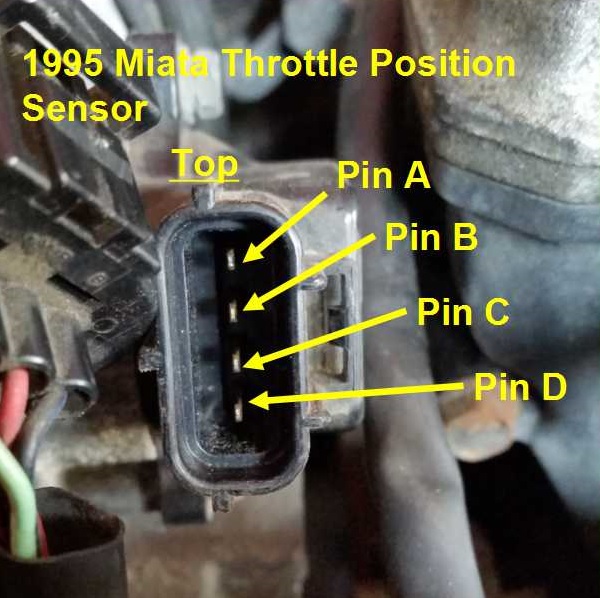
From the image below, Pins A & B are the variable resistor that changes as throttle is applied, and Pins C & D are the idle switch.
Apply an ohmmeter across pins A & B, the resistance should decrease linearly as the throttle is opened. For me, I had 3.26k Ohm at idle and decreased linearly to 1.06k Ohm at WOT (Wide Open Throttle).
Pins C & D should show a short (continuity between C & D) in static position, or idle position. Pins C & D should then show an open (no continuity between C & D) when rotated off idle position.
The TPS tested as good.
Ignition System
It should be noted the ignition col is the most expensive part in all the troubleshooting I was doing, so I was putting that off for last.
Pull the spark plugs and compare against the picture of analyzing spark plugs in most maintenance manuals. For me the spark plugs checked out, although most had a slight ash deposit indicating a rich mixture. [Confusing to me because the misfires indicated a lean condition].
I knew the spark plug wires were good because I had just replaced them earlier in the year with MSD spiral coil wires.
O2 Sensor
The O2 sensor is located on the drivers side just off the exhaust heat shield. There is a pig tail wire leading from the O2 sensor and connected at the main engine wire harness near the upper part of the rear of the engine by the ignition coil. Wait for the engine to warm up. This normally occurs within two minutes with the engine started from cold, and can be observed by a noticeable drop in rpm at idle. With the engine warmed up disconnect the pig tail wire of the O2 sensor from the main engine wire harness. Repeatedly and quickly apply large amount of throttle. If throttle response is normal, replace the O2 sensor. For me, I still had the “bogging” and misfires. So the O2 sensor was not the issue.
Fuel Pump
As I was troubleshooting I recalled the only thing in the stuff that I was checking that had changed within the past year was the fuel pump. I installed a new fuel pump last year. So I began to investigate the fuel system thinking I may have a bad unit. Seems unlikely, but I’ll check.
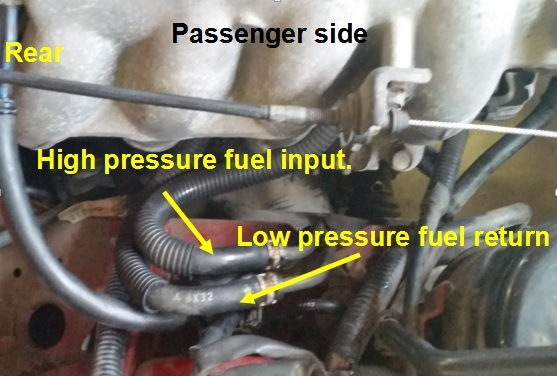
Connect a fuel pressure gauge (About $60 at your local auto parts store) to the high pressure fuel line. The high pressure fuel line is the rearmost of the two metal lines (passenger side of engine), pictured.
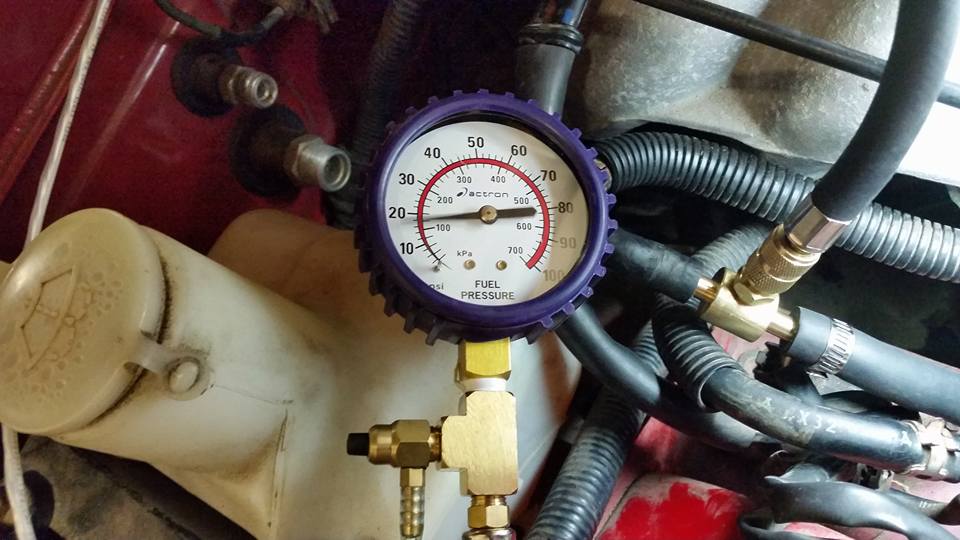
Pictured below is the pressure I read off the fuel pressure gauge. The Haynes manual states between 32-38 psi is normal, at idle. You can check the maximum output of the fuel pump by crimping the return line with a pair of pliers and observe the pressure. If it does not increase the problem is either the fuel pump, fuel filter or fuel feed line. Not stated in Haynes,, you can eliminate the fuel filter or fuel feed line as the problem by connecting the fuel pressure gauge right off the fuel pump coming out of the tank. I did and observed just about the same 20 psi as pictured below. Bingo! Now I’m getting somewhere!
Denso makes the part for Mazda so I got on Google and searched for the part. [The fuel pump that I replaced last year I bought at a local auto parts store and was made in Mexico]. I recommend, in hindsight, going right to the source. This car goes on track so I am looking for performance. I found a certified Denso part online for around $100. You local Mazda guy will ask around $400 for the same part. A 300% markup for spare parts by the manufacturer is not uncommon. What would we do without Google?
The part arrived [Made in Japan! Yea!!!] and I installed, including new high pressure small rubber hose connecting pump to the sending unit. The one I pulled off was a little cracked (after less than a year being in the tank).
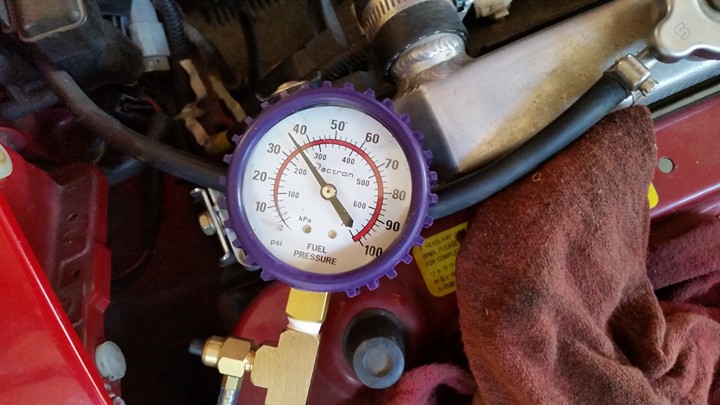
Pictured below is the new pressure number I saw at the fuel line in the engine bay. 35-36 psi is right in the sweet spot! Video below is how the engine now sounds with new fuel pump!
Summary
This is what worked for me. When I researched this issue online, I found other things that fixed the issue for other people, and other issues that were similar but not the same. I wanted to post what worked for me in hopes it may help someone else. Again, start most simple (like spark plugs, MAF connections) and least expensive, and work your way up. Good luck! There is nothing like the Eureka moment! and the feeling of solving the issue!
[I stated “seemingly” in the first paragraph when discussing throttle response, because I did know at the time that I had a fuel pump only capable of producing 20 psi, which was OK with the engine cold and using the hard coded AFM (Air Fuel Mixture) in the ECU of 14.7:1. I may have had this issue for sometime, and what I thought was normal, actually was not].