
Do you need a scooter?
Even those of you who despise scoots as fruity little girl-mobiles may have asked yourselves this question. That’s because a scooter is designed as a transportation device first and a recreational tool second. Contrast that with most motorcycles, which are often engineered with performance, cosmetics or other considerations placed before how efficiently the thing actually gets your butt from one place to another. Let’s face it: anyone who has ridden a scooter will tell you that for short commutes and errands, it’s hard to beat. Easy to ride, no need to work a clutch, your clothes stay cleaner, and there’s room for your stuff under the seat or in a locking trunk.
If there was a perfect scooter size, it would probably be on the smaller side of the spectrum. It’s always nice to have more power, but to make a scooter fast, it also has to be pretty heavy, and that weight is usually just where you don’t want it: in the giant swingarm/drive unit. Once you get too much over 150cc, that unsprung mass starts getting noticeable. If you need to go really fast, well, you have a motorcycle or a car already, right? Of course, too small and you start feeling ridiculous, not too mention terrified as you start losing stoplight drag races to homicidal Volvo-driving soccer moms and distracted delivery-van drivers. The sweet spot? 100 to 200cc, if you ask me.
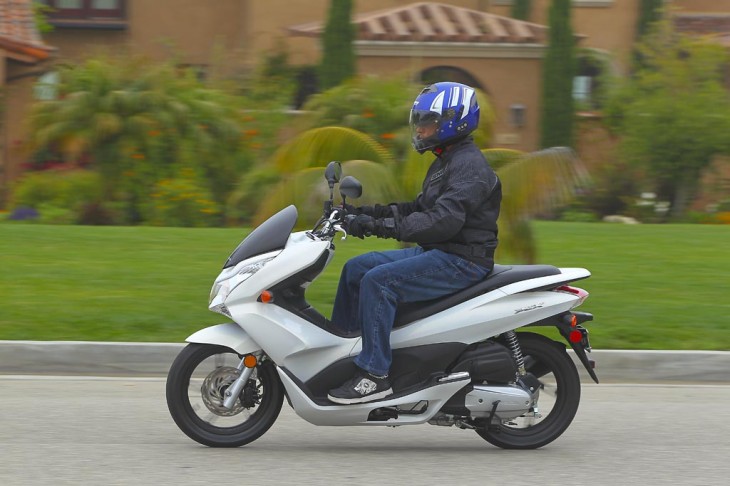
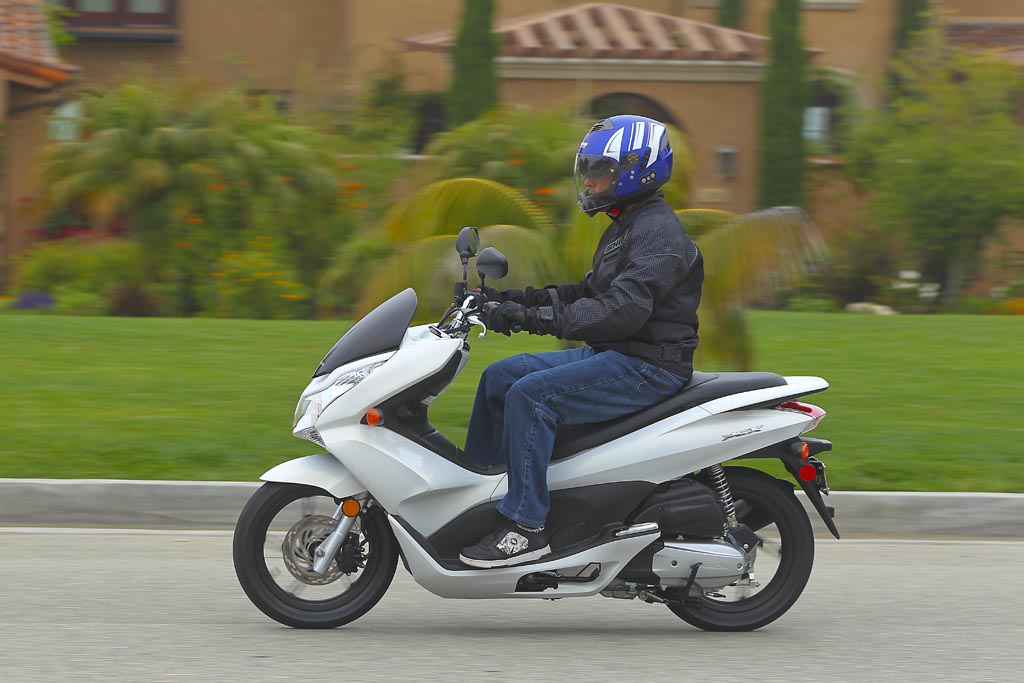
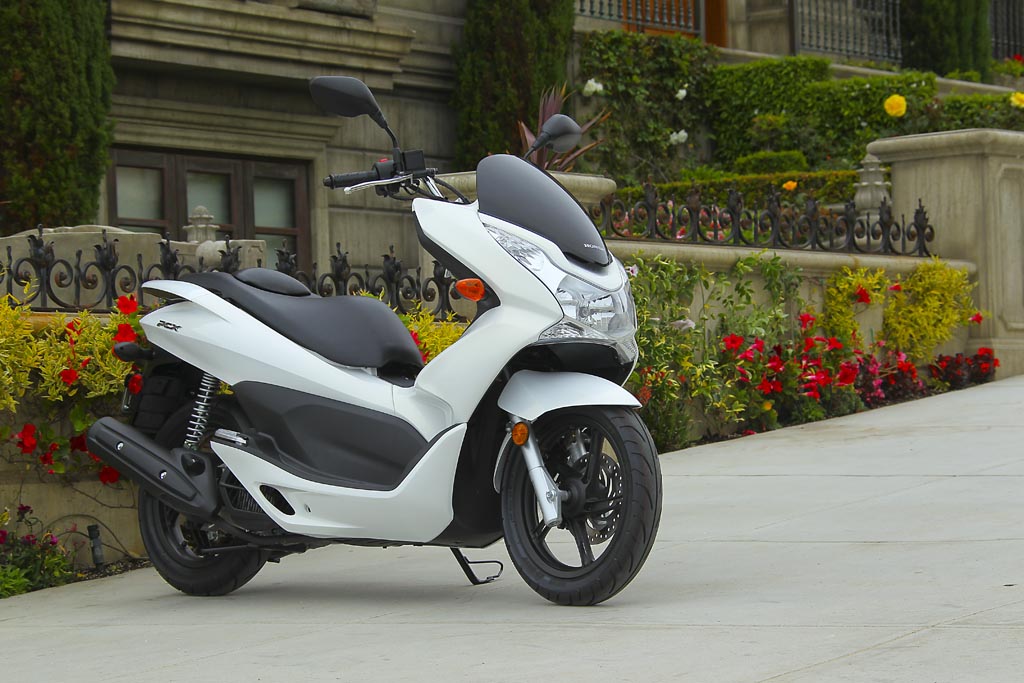
Honda must agree: Big Red now has three models in that zone: the SH150, and now, new for 2011, the PCX 125. Honda hopes it’s the perfect product: not too fast, not too slow, not too small and not so big that it will discourage newbies. The word is 60 percent of PCX owners will be first-time buyers. They may be a little confused over the pros and cons of the PCX vs. the Elite 110, as the two products perform similarly and are priced within $300 of each other, but Honda is probably figuring shoppers want more than one style of scooter in this price/displacement category.
For $3,399, that new buyer gets some technology you’d have to look hard and long for 10 years ago. The 125cc motor is a liquid-cooled, fuel-injected, single overhead cam design with an 11.0:1 compression ratio. Honda’s V-Matic automatic transmission gets power to the rear wheel. The frame is steel tubing with a unit-construction swingarm, and the wheelbase stretches 51.4 inches; compact, but not tiny. Wheels are 14-inchers with skinny bias-ply tires, a 90/90-14 in front and 100/90-14 in back—a compromise between the full-size wheels on the SH150 (which means less storage under the seat) and smaller wheels that give a jouncy, less-stable ride over urban potholes and bumps.
Braking is another area that sets the PCX apart. There is a 220mm disc and three-piston caliper in front, and a drum out back, but there’s also an interesting combined braking system. The rear drum is linked to the front three-piston caliper with a delay-spring mechanism that prevents the front brake from being activated before the rear, maximizing braking by evenly distributing stopping force between the front and rear wheels.
That’s a lot of tech on a 125cc scooter. So to keep costs down, the PCX is Honda’s first offering to the USA market from its Thailand factory, so it can still be priced affordably, if not exactly cheaply. But one technological trick left out is an “idling stop system” that automatically stops the motor during prolonged idling and restarts it as the throttle is turned. It’s claimed to net a five-percent savings in fuel economy but was left off the USA version because riding here tends to be a mix of urban, city and rural riding, which would minimize the benefits of the urban-intended system.
Like all Honda products, the PCX felt well-made, familiar and friendly. Build quality is quite good, with interesting design touches like the chrome bezel that swivels with the handlebar. I found the seating position very comfortable and natural, but taller riders than me (I’m 5′ 6”) may be a little cramped. The seat isn’t especially low at 29.9 inches, but it’s narrow enough at the front, so shorter folks can still easily handle the bike.
Honda’s obsessive product development comes through when you ride the PCX. The motor isn’t what you (or anybody) would call fearsome, but it does pull the 280-pound (ready to ride) scooter ahead of competing traffic, letting you maintain your space cushion and ride safely. I found the motor felt a little soggy in the mid range, and a little rough and buzzy nearing maximum rpm, but at your average 30-50 mph boulevard-cruising speeds, it was just right. Top speed can brush an indicated 60 mph if you have a gentle downhill slope.
Handling is where small scooters endear themselves to me, and the PCX has it right. Steering is quick and light, but it’s still stable and confidence-inspiring in high-speed, sweeping turns. There’s ample cornering clearance to have fun with too, although I did manage to scrape the centerstand tang once or twice riding Rancho Palos Verdes’ tight, bumpy coast road. The bike’s light weight is also handy when it comes to braking, as the small disc and three-piston caliper joined forces with the rear drum to produce quick, safe stops—it was difficult to skid the back tire.
After an hour of riding, the PCX showed it’s not a tourer. Even though the seat is comfortable for a while, there’s ample legroom for average-sized people, and there’s even a bit of wind protection, eventually I was feeling a little butt-burn and cramped. But I was stunned to find that the LCD fuel gauge hadn’t lost a single bar, even with 50 or more miles on the odometer. Maybe it was broken, but Honda claims 110 mpg, which means the PCX could squeeze 176 miles out of its 1.6-gallon tank.
That’s a good place to stop and talk about the economics of scooter ownership. At such a low buy-in, it’s clear a scooter owner would save thousands, even tens of thousands of dollars if he or she replaced a car with a scooter. But who’s going to do that? More likely you would supplement your car with a scooter, using the car to carry passengers and cargo and the scooter when it’s just a short trip to work or the store. So I did some calculations: if you rode the scooter 1/2 the time, and drove a 15-mpg SUV 1/2 the time, would the gas savings justify the approximate $1700 annual cost of financing, maintaining, insuring and gassing up a scoot like the PCX?
Figuring you drive 15,000 miles a year it wouldn’t make sense with $3.00-a-gallon gasoline: you’d only save $1,300 a year on gas, and the scooter would run you about $1,506 (not counting gas) the first year. But at four bones a gallon, you’d save $222 a year. And if gas got over the six-dollar mark, (“oh, that could never happen here,” you may say, but give it time), you’d save a thousand bucks a year, and still be able to drive a manly-man truck when you wanted to. Of course, there are other benefits to riding a scooter: parking costs may be reduced or eliminated, in California, you can lane-split through stopped traffic, and girls go crazy for scooters. Really.
Piaggio, the Italian company that makes Aprilia, Piaggio and Vespa-branded scooters, even has a word for this: scooternomics. It’s as if some cosmic force is paying you to ride a scooter. And can you put a price on the fun you know you’ll have (so long as your friends don’t see you), zipping along on a sunny day? Sure, scooters are slow, but piloting a 280-pound motorized vehicle is undeniably addictive. Just ask a Shriner.
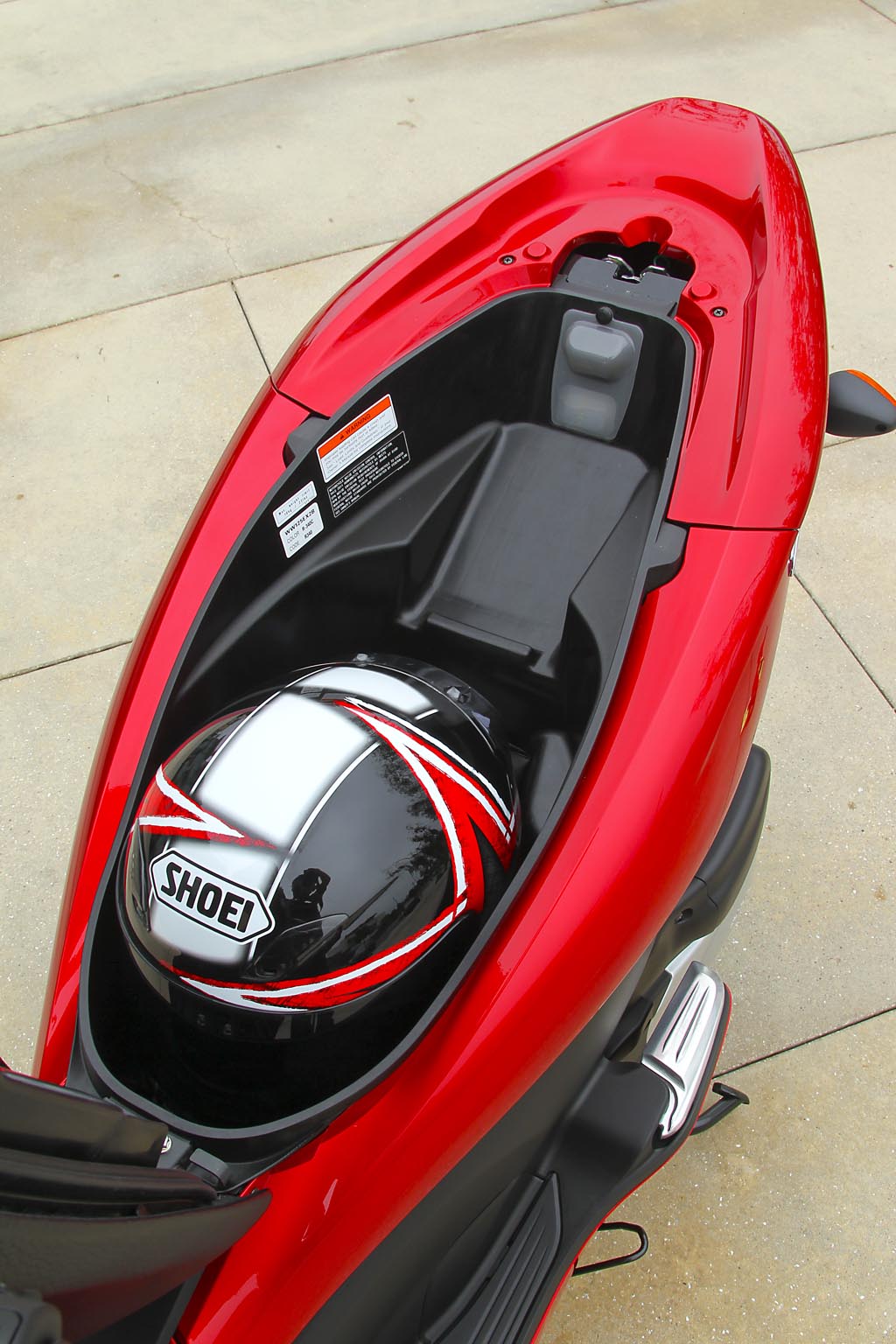
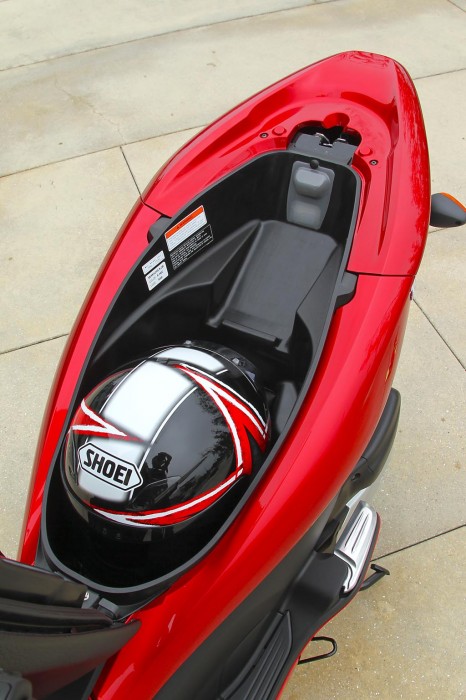
In that bopping-around-town mode, the PCX shines. Underseat stowage is generous—there’s room for a helmet and other gear under the seat (25 liters, in fact), and an accessory trunk can fit another helmet. No room to hang grocery bags (or a purse) on the front like some scooters—the frame comes up too high. But there’s a parking brake, full instrumentation, a locking ignition cover (to keep screwdriver-wielding thieves away) and a remote fuel-door release. Very classy. But the PCX is expensive compared to other 125cc scoots. Aprilia’s SportCity 125 is only $2899, and Kymco’s Agility 125 is just $2049. But some products are good enough to deserve a premium price; if you can afford the good stuff, get the good stuff.
So do you need a scooter? Not if you’re 100-percent satisfied with the way a motorcycle handles short-range missions. But if you do decide a scooter makes sense, the PCX is affordable, friendly, well-made and fun to ride. Wear a full-face helmet with a mirrored visor, and nobody will ever know.
Photos by Honda and Kevin Wing
You can follow any responses to this entry through the RSS 2.0 feed. Both comments and pings are currently closed.